Think! Before you React to Your Child’s misbehaviour

Child, Handling Misbehaviour, My Articles, Parenting, Toddler


As Featured On Ezine Articles

Based on a true story.

A Father just bought a brand new car, drove into his garage, get out and look at it from every angle. He saved for a very long time… to own a car. He put his hands on the top of the bright red vehicle, slowly sliding his palm across. His face was glowing with excitement and satisfaction.

Just as he was still admiring his new love, his little boy came over, tapped on his trousers and called “Papa”. The father looked down at his son, lifted him up, swings him around, hugged him and said: “Look, son, we finally have a car, shall we go for a drive?”

“Let me inform your mummy first”, said the father. He placed his son down and instructed that the boy wait for him there with the car.

After awhile, as the happy man and his wife was heading back towards his car, he could hear a very distinct sound coming from the garage…’dong’ ‘dong’ ‘dong’. He ran over to make sure that his son was not hurt in anyway.

To his disbelieve, his child was holding a small hammer, pretending to be a mechanic, hammering away as he was going around the car! There were dents all over the automobile. He could not believe his eyes. As he sees the child continues, his shock turned to anger.

In a split second, he shouted at the boy. The child was startled, looked at his dad with a blank face, as he sees him charging over. The father grapped the hammer and the child’s hands, without any hold back, he hammered his childs’ hands with all his might as he screamed:” you like to hammer my car? I’ll show you how it’ll feel when the hammer is on you…”

The mum grapped the mad man, pushed him down to the floor….rushed her bleeding son to the hospital. The 3 years old boy’s fingers were crushed, the palms had to be amputated.

As he lies on the hospital bed, he saw his father’s tears, the child comforted the father: “Papa, don’t cry, I’ll buy you a new car when I grow up. I promise to be a good boy from now on. When I am a good boy, my hands will grow back, right?” After hearing the words of his only child, the father went home and committed suicide.

Below is a report extracted from World Health Organisation Report extracted from World Health Organisation
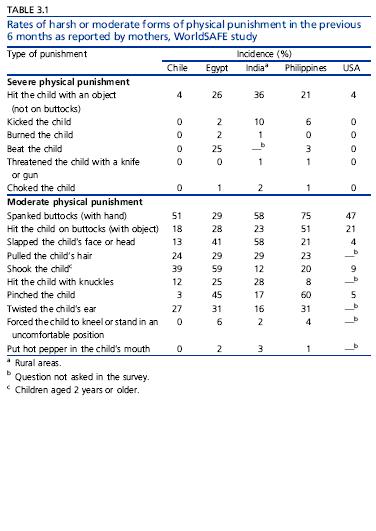
How many times have you shouted at your child because of your negligence? In this case, the father could have carried him along to inform his wife. If so, would this misfortune be avoided? I have seen mothers raising their voice when they saw their child holding a marker, scribbling on the wall and the furnitures. In the first place, why was the marker within the reach of the children? Change your tone, not your volume.

How many times have you smacked your child because you were in a bad mood? Bad day at work? Tireness? Learn to manage your anger. Your child can never learn the right way if he was never taught how to do it right. Don’t vent your anger on your child, respect his ignorance. Respect that every action that a young child does is not meant to do harm. In this case, the child was just playing, pretending to be a mechanic. Did you know that the very 1st time you hit your child, may result to an uncontrollable problem?I am aware of this danger because I was a victim and witnessed many of my friends who are much worse off than me. It usually starts off with a small slap on the palm, then the body, the face and it progress on to using objects to inflict pain.

It always begin as a warning to stop the child from doing what the parent didn’t like; then it became a habit and eventually it became natural; without you even noticing it! It’s dangerous to even start to lift a finger on your child.

Tip to discipline a child:

There are many ways to discipline your child. Over here, I would like to share a way for handling more serious misbehavior (children aged 2-10 years).

ü Use “quiet time” to stop a child from misbehaving. Ensure that this method is used for children who are old enough to understand its purpose.

ü Explain to the child that “quiet time” is a period for him to reflect on bad behavior. Tell the child why his misbehavior was unacceptable. Point out the correct behavior expected.

ü Let the child stay in a safe, isolated and boring place at home for a short while (1min for every year of the child, up to a maximum of 5mins). The child is to keep quiet and is not allowed to join in any activity. Never use a cupboard or storeroom for the “quiet time”.

ü If the child refuses to stay in the room or leaves the chair he is supposed to be on during “quiet time”, bring him back. You may even need to shut the door till he quietens down or behaves.

ü You must be prepared to persist with this technique and not talk to your child or give him any attention until “quiet time” is over.

ü After “quiet time”, talk to the child to ensure that he has understood your explanation. Reassure the child that he is loved.

ü Do not talk about the incident again. Encourage your child to find something else to do and praise him for this as you watch him.

ü If the behaviour occurs again, you will have to repeat “quiet time”. As the child learns the “quiet time” routine, he becomes quiet more quickly and “quiet time” is needed less often.

All children behave as well as they are treated.

- Jan Hunt

generated by sloganizer.net

1 Comment »

The Sociable 6s

Child, Development Stages, Parenting, Preschool

Characteristics

Short Attention Span Easily distracted, children at this age cannot concentrate too long on any one task.

Highly Active and Restless Fidgety and restless, six-year-olds have so much energy that they simply can’t sit still. They are always engaged in active play like running, jumping or tugging.

Eager to Learn They take an interest in everything around them, from wriggly worms to stars in the sky. Reading books, enacting stories and watching cartoons are high on their list of favourite activities.

Highly Competitive They are keen to compete in games and play and are very sensitive about it. In fact, most of them at this age are sore losers.

Strong Gender Affinity There is strong preference for friends and playmates of the same sex at this stage. Tips for Handling Six-year-olds

  • Develop in your child an interest of things in nature. Encourage him to collect sea shells, rock, etc. Stop to look at worms and insects together.
  • Introduce lots of books, tapes, songs, educational videos to your child.
  • Allow time for outdoor activities and things that hold his interests.
  • Teach your child how to play and compete in group games. Emphasise more on the values of group effort, team spirit and having a good time rather than on winning.

With this, it completes your understanding of your child from age 2 to 6 over the past week of posts…hope this helps.

When you understand your child’s behaviour, you can communicate better, react better, listen better and respond more appropriately. Frustrations is the result of lack of understanding and communication breakdown…avoid that.

generated by sloganizer.net

No Comments »

The Fascinating 5s

Child, Development Stages, Parenting, Preschool

Characteristics

Although KeatKeat and BinBin are no where near 5 year old, but I have seen so many 5-year-olds displaying the following characteristics, through my 3 years of helping out in a Child Care Centre, My nieces Cheng Han and Cheng Yee and my nephew Matin.

Seriously, I can’t wait till my boys are five, cos’ I am already so amazed by the little things they do and say everyday….I can’t imagine what more Fascinating Things the can do when they are 5.

Language Skills As they are good in language skills now, children love to talk, tell stories and quiz adults with wild questions.

High Initiative Five-year-olds are usually the first to start a conversation or to try new things.

Vigorous and Noisy Group Games Noisy and vigorous, these children enjoy games and play in groups of their own age.

Need for Approval Approval and acceptance are all important at this stage, so there is a definite desire to please and cooperate with both parents and teachers.

Sense of Responsibilities They feel ‘grown-up’ when they perform little tasks and duties and are always eager to help mum and dad to things like setting the table or washing the car.

Tips for Handling Five-year-olds

  • Plan time for conversation with your child. Read stories together. Encourage them to tell stories or share jokes with one another.
  • Recognise good work and reward them appropriately.
  • Organise games for their participation and do encourage them to join in group games. Put aside watching TV and get them out for the exercise they need.
  • Provide children with responsibilities in the house such as setting the table, drying dishes, picking toys, etc.

generated by sloganizer.net

No Comments »

The Frustrating 4s

Child, Development Stages, Parenting, Preschool

Characteristics

Inquisitive This stage is the age of many questions. Even when answers are given, the four-year-old continues to ask “Why?”
“yes..yes..yes” day in day out, “why this, why that?” Keatkeat will be 4 on 2nd November, so I think he is starting to show his Age 4 characteristics…
Think of it this way, deep in you, you want your child to be knowledgeable, or even more intelligent than his/her peers…
So other than ABCs and 123, which he learns in school, who else can he learn general knowledge from? YOU! How would you feel, when he say something or do something that create a “Wow! that’s a smart boy!” response from a stranger, and your child said:”Mommy taught me that.” *wink*
To all great moms of the universe: Take a deep breath and answer the questionssssss…

Talkative Because of their increasing capacity for language, children now tend to talk incessantly. This can often frustrate and wear out the adults!
*Laugh* yes…it can really bring up the blood pressure sometimes…but by just sitting back and looking at his energy, his enthusiasm, his relentless spirit, the intensity in his voice. You really can’t help but to be so amazed, “why have I lost that type of energy, ‘cos I strongly believe that I once had that when I was 4years old.”

Emotionally Unpredictable Children at four can often burst into laughter or tears at the same time! There are also sudden bouts of anger but the squalls are over quickly.
Thank God! The squalls DO GO AWAY QUICKLY…

Lively and Sociable Full of energy and life.
How they enjoy being with other people now!

High Moto Drive The swings, the monkey-bars, the jungle gym, cycling…their need for muscular movement drives the four-year-olds to frequent activities.
Whenever its not raining, after his nap, he would definitely ask: “Playground is not wet already, we can go play now, right?”

Tips for Handling Four-year-olds

  • Encourage the child to ask questions. If you don’t have an answer, find out the answers together with the child - look up an encyclopedia, visit the local library, etc.

Do that! Its fun learning TOGETHER. You will be surprise at the number of things he noticed and asked you, and Ooops, you don’t know the answer! Huh?! Didn’t “you eat more salt than he eat rice?” - that’s how we say it in Chinese to someone that should be more knowledgeable in comparison.

  • Encourage lots of large motor skills activities. Allow them to climb, swing, ride a bicycle, jump, etc. Be sure to take safety precautions so that the child can play heartily.

Safety first, never forget.

  • Talk to your child, read to your child. Build on his vocabulary skills. Allow him to participate in your conversion.

Occasionally, when my husband and I are in a not-too-serious kind of conversation, we would ask Keatkeat’s view. He loves to give his views, man!

  • Provide opportunities for your child to have social activities. let them invite friends home for a party, or have a popcorn night.

My husband has two elder brothers, all married with children. Every Sunday, we would bring the kids to their grandparents’ house, everyone will come together. We call it the ‘family day’. That’s the regular time for the kids to mingle and update each other what new toys or gadget they bought over the week. …..and a time for parents to relax…phew!

generated by sloganizer.net

No Comments »

The Trusting 3s

Child, Development Stages, Parenting, Preschool, Toddler

Anxious to Please Children conform readily at this age because they like to please adults and get approval and acceptance.
KeatKeat is always asking me: “I do this and you’ll be so proud of me ah?” “Am I a good boy today?” “I didn’t make you angry today, right?”

Cooperative They enjoy following instructions and working with other children. They also like to share now, because they are very interested in other people.
If you read my first post Understanding Your Child, you would know that KeatKeat was not such a child then….the nursery class this year helps to build his social skills too. Now he is just so eager to mix around with his friends and new kids he meet.

Very Energetic They are on the go almost every minute of the day and tire themselves out easily.
Yes! His would take a blanket, cover his head and pretend that he is holding the Chinese Lion Dance head and kept dancing up and down tables and sofas as if they were the stilts… sometimes he get so engross in it that he would knock around and still continues…. the whole time you can hear “jiak dong chiang, jiak dong chiang, dong chiang dong chian….”
Believe it, he can do this whole day if the Chinese Lion Dance VCD is playing at the same time.

Highly Imaginative They live in a world of make-believe and are not yet able to distinguish between the real and the imaginary. They will believe you if you tell them that the big, black dog is a bear.
Well, he always imagine that he is a racer in a sports car. Sometimes he makes me feel his cars are more important than his life. He must always ‘race’ before he goes to bed, after he wakes up, before meal and after meal….meaning he is racing almost all the time!

Tips for Handling Three-year-olds

  • Praise the child for work well done, obeying, or helping out

Don’t just say Good Boy or Good Girl. Be creative, use different words, it increases vocabulary learning too. Say Good Job, Smart Boy, You impress me!….

  • Provide active games and fun for the child, but be sure to give him rest periods throughout the day.

That is sometimes a challenge. ‘Cos the kid is so pumped up, he became unstoppable! Try this : When you want him to stop, give him a time frame or some sort of gauge. Let’s say you are playing hide and seek, you can say “This is the last round or last 2nd round, after that we need to rest. We will continue another time.”

Or if your child can tell the time already, simply says “5mins more“. If your child still can’t tell the time, but can recognise numbers, point to the clock and say “when the long hand touches number 12, we need to stop this game, drink some water and rest.”

  • Provide time and materials for imaginative play. Play “Guess where I hide”, “Can you be a bear?” with the child
  • Provide cooperative activities for the child and his siblings, and also with his neighbours.
  • Praise him for working together with others.

share with me your experience with your child. I would love to learn from you.

generated by sloganizer.net

No Comments »

The Trying 2s

Child, Development Stages, Parenting, Toddler

Negativism “No, No, No…!” is a very common response from children at this age, to everything parents ask them to do. They really say “No” without really meaning it sometimes.
- My younger son, BinBin, can say “No” very loudly in a split second after I ask him :”Do you want to try this?” handing him a sweet he has never seen before…”NO” to a sweet, duh….

Temper Tantrums Two-year-olds who can’t get what they want throw tantrums very quickly, but get over them very quickly too.
- continuation from above, when I turn to my elder son and pass him that same sweet, BinBin simply went crazy and start banging his head on the floor or wall….I am serious, my BinBin really does that. I guess that’s probably why you can feel humps on different parts of his head. He just continues till you GRAB HIM. He will just continue to struggle like a fish out of the sea. Thank God he has tone down so much now. What I did to prevent head banging was to just leave the sweet in front of him, on the floor or on the table, after some minutes, he will come back for it, even though he may walk away as if “I said ‘NO’, didn’t you hear me?”

Great Curiosity They test it, taste it, press it, squeeze it…so don’t leave anything dangerous lying around!
-Ya man, he practically feel all his food. He was rolling and squeezing the Roti Prata (an indian pancake) during lunch, even though I have already tear them into small bite-size, like as if he was playing Play Doh.

Possessiveness and Destructiveness Children at two definitely do not like to share their things. They also like to find out about everything, so toys can be easily broken or torn apart.
-I had to keep reminding him “Love your toys and they will stay longer with you” or “When you slam the car on the floor, the car can feel the pain, it thinks that you don’t like him“. You know, when you use words of emotion, like love, sad, angry…it works on kids really well. At least it works on all the kids I have come across so far.


Tips for Handling Two-year-oldsThis may seem like a trying period but there is really no need to be overly concerned. Two-year-olds are at a stage of exploring the world around, trying to master skills on their own. They seek to achieve autonomy and to satisfy their curiosity. Thus, when they are frustrated, they have outbursts of tantrums and anger.

  • Provide lots of room for exploration in their environment. Offer play things they can touch, press and taste. Give them toys that boost creativity and encourage exploration.

I love to give BinBin a big piece of blank paper and crayons. He will start drawing lines and circles…and when you ask him “what are you drawing” he can actually tell you a Story. By the way, my BinBin speech development was very much ahead of kids of his age. He can speak as much things as his brother, a 4year old. Other common toys would be lego and building blocks

  • Distract the child when he is frustrated by providing alternative activities. Or, give him a hand if he can’t cope with a certain task.

Observe that the frustration starts coming up, quickly grab something else and start introducing him to the new stuff. Once the frustration becomes ‘full blown’ its harder to distract him.

  • Provide durable toys so they are not easily broken.
  • Make a game out of the task you want him to do if the child responds with a “No!”

generated by sloganizer.net

No Comments »

Understanding Your Child’s Development Pattern

Child, Development Stages, Parenting, Toddler

By recognising the developmental patterns of early childhood, parents can help provide guidance and activities suitable for their children and ease their transition from one stage to the next.

It is important that at each stage parents do their best to meet the needs of their developing child.

With encouragement, praise and a bit more patience, parents can develop a strong and meaningful relationship with their child, laying the foundations of understanding early, from toddlerhood to pre-school age.

Although no two children are exactly alike (mine are almost like North and South Poles) definite development patterns can be observed in young children aged two to six years. These patterns was what I observed during my 3 years of helping out in a YWCA Child Care Centre when I was in my teens. I will broadly outlined the patterns here to help parents understand the age-group characteristics and be more effective in their parenting over the week. So doesn’t seem like too much to read for a start.

So remember to come back daily over the week….

generated by sloganizer.net

No Comments »

Understanding Your Child

Parenting

why are you so naughty?

why can’t you keep still?

are you listening to me?

why don’t you do what I say?

Ain’t those questions above so familiar? You probably say them to your child almost everyday, especially if your child is in the 3-4 years group.

Children can sometimes be difficult to handle with their negative moods, strong self-will and intense emotional responses. However, they have their own strengths and abilities too.

As unique individuals, they possess their own special set of qualities and, by understanding them better and learning about their temperament, you will be better able to manage them successfully.

While growing up, children are bound to make mistakes as they test their limits (and yours!). As a result, they can prove to be somewhat difficult at times. You have to accept, respect and love your children regardless of this and help them cope with life’s changes and challenges.

My elder son, keatkeat, is a thinker. Everyday, he never fails to amaze me with the details he noticed in things he observes in school, the behaviour of people around him, the events that’s happening everyday, etc.

In the beginning, he hardly talks. We (my husband and I) took quite a bit of effort to let him speak his mind. We would first notice what is he looking at and touching whenever he is extremely quiet.

Then we would create a topic around the thing that is getting his attention. Eg. if he was holding a car and rotating it around. We would say something like, you like this car don’t you?

Usually we break the ice by asking something that will give a positive answer like yes and ok. Then we go on by asking what’s the details of the car, eg. colour, size. If he continues to answer our questions, we then go on to open ended questions like “you look like you are talking to the car, what are you saying to it?”

Yes this may sound silly, but in the imaginative world of a child….you never know! Well, this method worked for keatkeat.

Now, he tells us almost every single thing that’s on his mind, and best of all, he talks to strangers!

I still remember the very 1st time he talks to a stranger. We were in the lift of our HDB flat. A man was in the lift with us. He said ‘hello’ to keatkeat, we were expecting the usual head-bow-down kind of reaction from him, instead, keatkeat said ‘hello’ and waved!

If you have kids that are quiet, seldom talks, and it worries you, share with me, I always like to try new ways to break the ice. Leave a comment. Love to hear from you.

Even if you don’t have a child like keatkeat, give me your feedback on this very 1st post of mine.

Bookmark this little blog of mine, keep coming back to know how you can enjoy your parenting days….

2 Comments »