Hand, Foot and Mouth Disease

Child, Health, Parenting, Preschool, Toddler
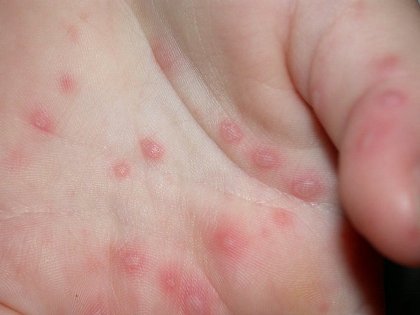
hand_foot_mouth.jpg


Currently, there is an outbreak of HFMD in Singapore, with 702 cases reported on the last week of March, bringing the total number this year to 4,423 cases. Last year, Singapore registered a record of 20,005 cases.

SINGAPORE is developing the world’s first diagnostic kit for Hand, Foot and Mouth Disease (HFMD) that will help detect the virus in febrile children within 10 to 20 minutes.

This means that children with the highly contagious HFMD can be picked out and quarantined sooner, thus minimising the chances of their passing on the virus to their peers.

Beginning of this week, the children, in Keatkeat’s school, needed to queue up for temperature check before they could step into the class. This really eats into the time for learning.

Yesterday, a temperature record sheet was given. All parents were advised to record down their child’s temperature before he/she goes to school every morning. As expected, some parents just don’t follow instructions or they may have forgotten, so the queue still exist.

Out of 22 children in the class, only 3 remembered to take the temperature at home before coming to school, and Keatkeat is one of them. Yeah! So he gets to play while the rest are waiting for their temperature to be taken.

Currently, the diagnosis of HFMD — a common childhood disease — is symptomatic, which means that children are being screened for the virus only when they show up with a rash with blisters on their palms and soles, and mouth ulcers.

The HFMD test kit, however, will be able to detect the virus in a child who has fever, since the NUS medical school’s paediatric department has identified a marker in the viral protein that can be used in the kit.

EV71 has been associated with serious complications. In 2000 and 2001, EV71 killed more than 70 children in Asia, including seven in Singapore.

There are 6 students in Keatkeat’s class being quarantined at home already. Keeping my fingers crossed, may Keatkeat sail through this smoothly…..The scary part about this disease is its contagious before the blisters appear. So you never know who has it, till its too late.

The HFMD test kit will only be available in 3-4 years time….sigh…so for now, all we could do is make sure Keatkeat’s hands and feet are always washed thoroughly every-time he comes home from school, before he touch any toys…or little Binbin will be in danger too….


Copyright © 2007-2026 All About Your Child. The contents on this blog are the sole property of the author, Angeline Foong, and may not be used or reproduced in any manner without consent. All Rights Reserved. 9 Comments »

Glandular Fever

Health


Has the illness-lightning strike on my house? All of a sudden, everyone seems to be contracted with a sickness that is unheard of in the family. First, hives and now this….

But still it always feel good to know why you are sick. Another good thing is I am not bedridden now (like I mentioned in my previous post). Also, I found out that I have glandular fever. Did a little research from this site. Lots of stuff to read, but at least it ease my mind. Extracted some main info here: –

Symptoms
Many people, especially children, have few or no noticeable symptoms of glandular fever.

If symptoms do occur, they usually include:

  • swollen, enlarged lymph nodes;
  • high fever (temperature above 39C or 102.2F);
  • very sore throat;
  • swollen tonsils, with a white coating;
  • tiredness and lack of energy;
  • loss of appetite and weight loss; and
  • muscle aches and headache.

Causes
Glandular fever is caused by the Epstein-Barr virus. It is passed on through saliva and the mucus produced in the nose and throat….. A person with glandular fever is most infectious when they have a fever. (maybe I got it from Keatkeat, remember he was having night-fever)

Treatment
In the mildest cases of infection with the Epstein-Barr virus there are few or no symptoms, so no need for treatment.

When symptoms do appear, treatments are aimed at soothing them, as there isn’t a cure for glandular fever. The virus usually runs its course within a month, as your body produces antibodies against it, and many people will recover without treatment within a week or two.

When you are feeling unwell, tired, or have a high temperature, you should rest and take plenty of fluids such as water. Paracetamol or ibuprofen (or child equivalents) can be used to reduce pain and fever. Antibiotics are not given because glandular fever is caused by a virus…..

Self-help measures for a sore throat include gargling with salt water or sucking on throat lozenges. In rare cases when swelling in the throat is severe, and interferes with swallowing, or if the nervous system (brain and spine) is affected, treatment with corticosteroid tablets such as prednisolone may be used.

Complications
Most people recover from glandular fever within a few weeks, but occasionally serious complications can occur, including:

  • damage to the nervous system, such as inflammation of the brain (encephalitis or meningitis);
  • ruptured or damaged spleen;
  • hepatitis;
  • pneumonia; and
  • anaemia.

Its estimated that around one in ten people who have glandular fever go on to have long term, chronic fatigue syndrome, with occasional fever and lymph node enlargement.

Not going to focus on the complications….just focusing on getting well in a week or two….wish me luck again…


Copyright © 2007-2026 All About Your Child. The contents on this blog are the sole property of the author, Angeline Foong, and may not be used or reproduced in any manner without consent. All Rights Reserved. 4 Comments »