A new study in Washington provides some of the best evidence to date that breast-feeding can make children smarter, an international team of researchers said on Monday.
Children whose mothers breast-fed them longer and did not mix in baby formula scored higher on intelligence tests, the researchers in Canada and Belarus reported.
……At 3 months, 73 percent of the babies in the breast-feeding encouragement group were breast-fed, compared to 60 percent of the other group. At 6 months, it was 50 percent versus 36 percent.In addition, the group given encouragement was far more likely to give their children only breast milk. The rate was seven times higher, for example, at 3 months.
The children were monitored for about 6 1/2 years.
The children in the group where breast-feeding was encouraged scored about 5 percent higher in IQ tests and did better academically, the researchers found.
Previous studies had indicated brain development and intelligence benefits for breast-fed children.
But researchers have sought to determine whether it was the breast-feeding that did it, or that mothers who prefer to breast-feed their babies may differ from those who do not.
The design of the study — randomly assigning babies to two groups regardless of the mothers’ characteristics — was intended to eliminate the confusion.
‘MOTHERS WHO BREAST-FEED … ARE DIFFERENT’
“Mothers who breast-feed or those who breast-feed longer or most exclusively are different from the mothers who don’t,” Dr. Michael Kramer of McGill University in Montreal and the Montreal Children’s Hospital said in a telephone interview.
“They tend to be smarter. They tend to be more invested in their babies. They tend to interact with them more closely. They may be the kind of mothers who read to their kids more, who spend more time with their kids, who play with them more,” added Kramer, who led the study published in the journal Archives of General Psychiatry.
(That’s me, that’s me….)
…..The researchers measured the differences between the two groups using IQ tests administered by the children’s pediatricians and by ratings by their teachers of their school performance in reading, writing, math and other subjects.
Both sets of scores were significantly higher in the children from the breast-feeding promotion group.
Kramer said how breast-feeding may make children more intelligent is unclear.
“It could even be that because breast-feeding takes longer, the mother is interacting more with the baby, talking with the baby, soothing the baby,” he said. “It could be an emotional thing. It could be a physical thing. Or it could be a hormone or something else in the milk that’s absorbed by the baby.”
……Previous studies have shown babies whose mothers breast-fed them enjoy many health advantages over formula-fed babies.
These include fewer ear, stomach or intestinal infections, digestive problems, skin diseases and allergies, and less risk of developing high blood pressure, diabetes and obesity. Read full report here…. (the report was removed from the Internet.)
Hey, non-1st time Mommies out there who have been giving excuses to breast-feed your baby, its time to change your mindset now!
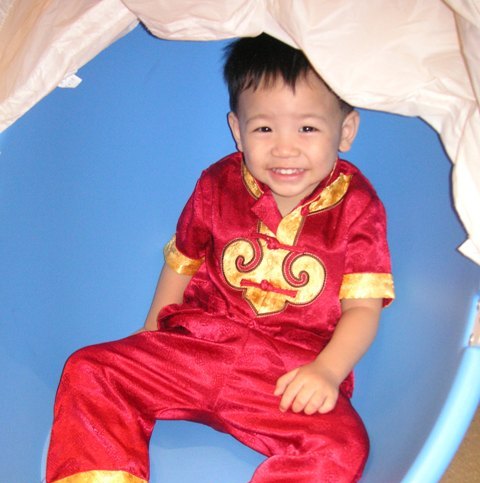
In 4 days time, my little Binbin will be 3 years old. Its during such times, the very cliche question comes to mind, “How time flies.” Then I start going through the baby photos.
I call Binbin my miracle boy because I conceived him at a time that’s impossible to conceive. Hey, I am not referring to the ovulation cycle or about miscalculation. He was ‘manufactured’ on a day when there were no ovaries in me. Did I hear you say, “Huh?” Nevermind, just take it that God magically put Binbin into my tummy, that’s how the miracle kid came to this earth.
The day he was born at KK Hospital on 30th March 2005. He had a girly look, doesn’t he?
One week after he was born, we realised that he sleeps with his eyes half open (yes! 50%). You can see his eye balls moving left and right as if he is awake. Till this very day, his eyes are still half open when he is in dreamland. Some old folks say, its a sign of naughtiness. (humph)
As if being proclaimed as a naughty boy, even when he was not even big enough to defend himself, was not bad enough, Allan’s parents spotted the 2 “turners” on the top of his head (seriously, I don’t know what you call this, so please tell me the name if you know).
They slapped with this conforming sentence, “This boy will be a terror. Very stubborn. Very naughty. Very disobedient.”
Sometimes it really makes you wonder what really goes through the minds of the older generation. How can that be related to a character or personality? All my aunts and uncles said I was the best baby, toddler that anyone could have ‘cos I am faarrrrrrr from being naughty, and lo and behold, I sleep with my eyes half open too!
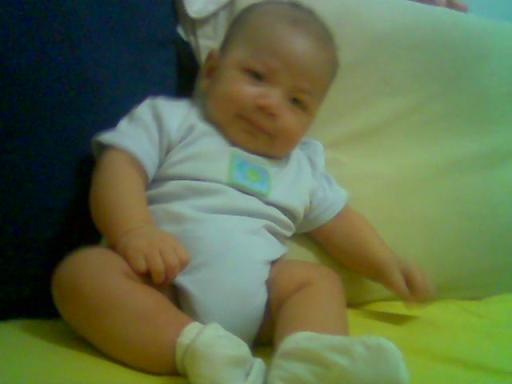
This picture was taken on his first day of his 4th month. His fatty thighs could actually support him quite well. All thanks to breastmilk. So mommies out there who want a chubby little baby but do not want an overweight baby, Breastfeeding is the answer.
I breastfed him for 6 full months without any formula before I get back to work at my stall. Much longer than my elder one because Binbin was free from those classic objections.
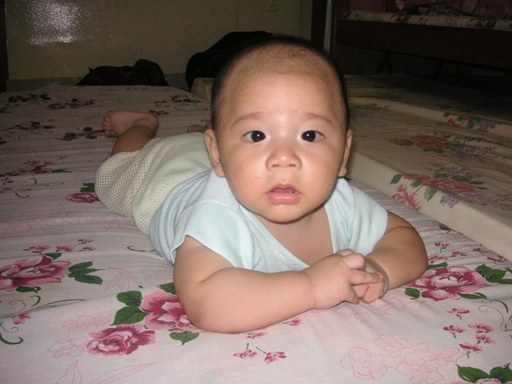
Here’s the little one on his tummy. He could lift up his head and hold it up for more than a minute.
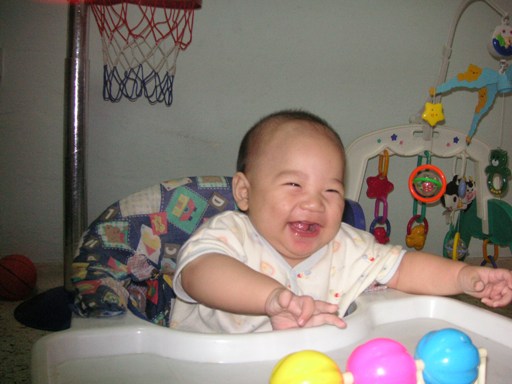
My adorable kid on his walker. Always love to see his smile, or laugh rather. Yup, my boy is more of a laughing boy than a smiley one.
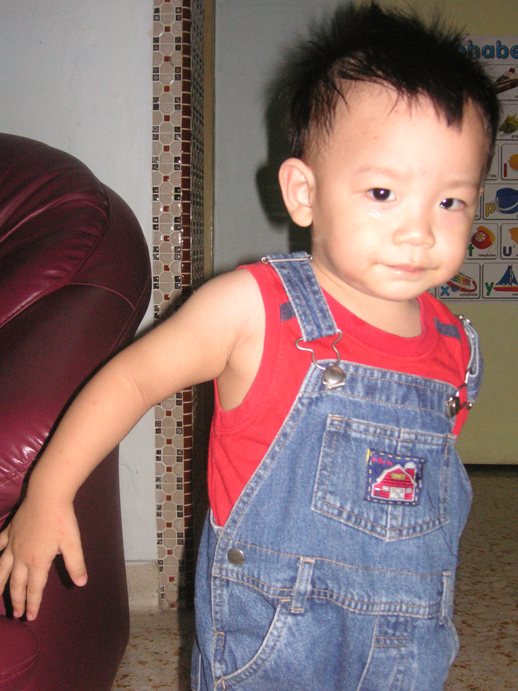
Able to walk quite steadily on his own at 13 months. Just got up from a fall, still can see the tears in his eyes.
This was also the time when Allan and I called Binbin, ‘The Little Werewolf’. Why? Every month, there is bound to be a day, he would go crazy. I am not talking about tantrums. I really mean CRAZY. He would suddenly cry and shout for no reason and smash his head onto the wall. He will not stop even when the force of the bang caused him to bounce off the wall! He will just get up and bang his head on the wall again, till we hold him down for minutes. Its was bewildering. Thank God, those days were over. If not we would have trouble holding this 15kg boy down with his forceful struggles.
Since then, we realised that he had a very big threshold for pain tolerance. He can bang his head on the edge of the steel door, resulted in a dent on his forehead and he doesn’t even shed a tear. Remember my post on his unbelieveable ability to withstand pain? So far the only time he cried in pain was the bloodshed during earlier part of this year. Only such pain could make him wail. Amazing ya?
Right after his 1st birthday, we noticed that his development, in terms of behaviour, motto skills, intellectual and especially speech is extremely fast. Now he can perform whatever a child who is 9 months older than him do and sometimes can do even better.
Because of his super advanced development mentally, I tend to compare him with his elder brother who is 15 months older (I know its wrong of me but it just come naturally). Binbin is able to do certain things like cleaning himself after passing motion much better than his brother. He shits in less than 1 min. Clean and fast. Never had to worry about any mess when doing it out of the house. All he need is 1 – 2 wipes.
Binbin is a definite vocalist. So long as he is awake, its difficult to have peace for more than a minute. You either hear him babbling away, singing aloud, laughing or crying his lungs out. He spoke his 1st word clearly at 9 months and what’s that word? ‘MOON’. He was able to speak in a sentence of 8 words at 1 year old; sing a complete song at 18 months. Half a year ago, he was able to tell me the entire story of the 3 little pigs. Now he knows as many vocabs as his 4 year old brother.
I never had to worry that Binbin is not eating well, because eating is his hobby! He is ADDICTED to Vegetables. From anything that’s leafy to cucumber, carrot, cauliflower, potato; Favourite vege is broccoli, don’t you wish he is your boy?! *wink* When other kids at Kentucky Fried Chicken is changing their coleslaw to whipped potato, my Binbin needs to have 2 servings of coleslaw in order to satisfy his desire. His favourite snack is a slice of Chesdale Cheese.
He is very special….not the normal special as in the hearts of the parents but special because of all the above….or rather unusual for a kid. Other than his cute actions he is always mistaken to be the twin brother instead of the younger brother whenever my boys are out with me.
Most kid’s favourite songs are the usual Twinkle, twinkle little stars or anything of that sort. But my boy grew up with Chinese pop songs, (although he can hardly speak a proper sentence in Chinese) his favourite is Fairy Tale from sentimental king-Guang Liang. This is Binbin, singing the chorus….
Another very peculiar thing about Binbin is his soft personality. He is very boyish in every way on the outlook. With the natural punky hair, he is rough in his behaviour most of the time, but he has a heart of a girl.
He is attracted to things in Pink. Until lately, he tries to control his affection because too many people kept telling him that pink is for girls. (Says Who!!! ) He loves to play with my sister’s Barbie doll Kitchen set too.
He is in love with Minnie Mouse. I feel perfectly great about that! Though many times the expressions from strangers are not very supportive when they see my 2-year-old boy holding on to a Minnie mouse (as if its his, which he grab it off the shelf the moment his feet stepped into the toy dept) and walk around with it as he examines the kitchen set for the Barbies to play.
Then off he went to press buttons which makes the ‘Baby-Alive’ doll blink and speaks, before he went off to the car section where he checks out for any new hot wheels models.
When we are ready to leave the dept, he would kiss Minnie (sometimes) and say goodbye before putting her back to where she belongs.
He likes to cuddle soft toys. When he is in a snuggling mood, he would hug his favourite puppy and bear to sleep.
So now if I tell you one of his favourite cartoon is Stawberry Shortcake, that wouldn’t suprise you in anyway right? Other than every cartoon in Playhouse Disney Channel, he is very much a challenger at heart. He looooovvvveeees to watch FEAR FACTOR and AMAZING RACE. His eyes hardly blinks till commercial break. Animal Planet is the next on the list. Animals just have a special link to the hearts of kids, don’t they?
Talking about animals, Binbin loves animals, errrr….but his excitement may cause some animals to have heart attacks. He doesn’t really know how to express his emotions, so what he does is, he would chase my neighbour’s dog and hold it down on the floor and say “catch you”, then he would release his grip again and let the dog run (which the dog definitely would in attempt to escape from the clutches of my boy.), then “catch him” again. To him its playing, but to the poor animal, its tormenting. Poor dog.
He is 100% mommy’s boy. He hugs me like a bolster together with his real bolster to sleep. He ticks my cheeks with his little index finger, whenever I look at him in the eyes, in silent admiration; and as if to break away from his shyness, he would say, “Mommy, you sooooo cute.”, squeezing my cheeks with his hands. He can say “Mommy, I love you” so many times a day, sometimes it makes you wonder if its true. Of cos’ I know its from his heart. Kids at this age don’t lie right?
Yup that’s my 2-year-old boy. I love you, Binbin! In 4 days time, you are going to have your very 1st birthday party. I owe it to you. Finally Mommy don’t need to work in stalls 12 hours a day, 7 days a week. Hope you like the suprises that everyone has prepared for you.
Angeline Foong is my name. Making people happy is still my aim — that part never changed.
Some of you have known me here since 2007, when this was a place I poured my heart into as I raised my two boys — the tantrums, the milestones, the 'unconventional' parenting moments I couldn't help but write down. I stepped away from this blog for over 10 years. Life, and my boys, grew up. Men now.
But somewhere in those years, something else grew too. Watching my own family up close — really up close — taught me that most of our struggles, with our kids, our partners, our parents, even ourselves, come down to one thing: we don't always understand the person in front of us, or why they do what they do.
So I went looking for a way to change that. What I found — and eventually developed myself — is a tool called the Numbers Decoder. It uses something as simple as a birthdate to reveal how a person is wired: how they think, how they connect, how they need to be communicated with. Once you understand that about someone, you can choose how you show up for them — instead of guessing, or worse, assuming they should just be like you.
Today, as a Relationship Consultant & Coach, helping people navigate the relationships that matter most — with partners, family, colleagues, and themselves — through 1-to-1 consultations.
This blog is where I'll be sharing that journey again — this time through real case studies from the people I get to help. Same Angeline, same belief that no relationship issue is unsolvable with enough understanding and patience. Just a much bigger definition of 'family' now.
Welcome back, old friends. And welcome, new ones.
Leave a Comment before you go.
Too shy to say it out loud?
Then email me at AskAngelineFoong@gmail.com